• Video tutorial on roof insulation, water feature, roof garden
  • Video tutorial on roof insulation, water feature, roof garden
  • Video tutorial on roof insulation, water feature, roof garden
  • Video tutorial on roof insulation, water feature, roof garden
  • Video tutorial on roof insulation, water feature, roof garden

Video tutorial on roof insulation, water feature, roof garden

  • View: 3637
  • updated: 01 Dec 2025
  • Expire: Wednesday 31 Dec 2025
  • 21.83 USD (Valid until : Friday 27 Feb 2026)
  • In stock: 25
  • Weight: 10 (kg)
  • Last Login : 3 Day ago
  • Rate: ( Rate count: 1 ) Add a Comment
Contact with the company Start order
  • 3 Year

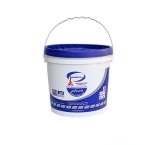
In the links below, you can watch videos recommended by Titan experts for effective waterproofing of bathrooms, roofs, and roof gardens using Stop Leak waterproofing. https://nanotitanco.com/page/roofgardenvid https://nanotitanco.com/page/wcvid 1- Roof Waterproofing: Roof waterproofing is one of the most common types of waterproofing performed in buildings. Although there is generally no negative water pressure on roofs, due to direct exposure to the atmosphere, paying attention to the climate of each region and understanding its changes when selecting the type and method of insulation and its durability is very important. How to waterproof a roof? Roof waterproofing is one of the most common types of waterproofing in the construction industry, commonly done using bitumen-based insulation. Bituminous membrane and asphalt roll roofing are among the most common insulations used for waterproofing roof surfaces. Just as technology advanced and asphalt roll membrane replaced traditional bitumen work, today new polymer-based insulations with improvements over asphalt membranes are replacing them. Selecting the right insulation for the roof is one of the key steps in roof waterproofing. What should we consider when buying suitable insulation for building waterproofing?

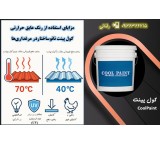
  • Climate: One of the most important factors in choosing insulation for roof waterproofing is attention to the climate where the building is located. Hot weather causes many insulations to soften, showing up in ways such as:
    • Dripping of the insulation (mainly bitumen) from under the ceiling
    • Flowing of insulation into drains and blocking them
    • Inability to walk on the roof during hot hours due to softening insulation Cold weather causes many insulations to dry out and crack. Cracks mean waterproofing failure. In the past, professionals addressed these issues in bitumen by mixing various ratios of hard and soft bitumen depending on the temperature, which was a skillful task. But more important than average air temperature is the temperature difference between night and day and between seasons in the area. In desert areas with large day-night temperature differences and mountainous areas with sharp seasonal changes, this becomes challenging because even professional estimation of mix ratios cannot fully fix the problem.
  • Adhesion of insulation to surface: This feature must be examined from two perspectives:
  1. Adhesion strength of insulation to the dominant surface material
  2. Adhesion strength to other materials used on the surface The waterproofing insulation must stick securely and reliably to the surface without detaching. Identifying the dominant surface material and estimating adhesion strength accordingly is critical. Note that sometimes the insulation adheres well to the dominant material but since the surface is heterogeneous with other materials, poor adhesion to those can cause separation and failure of overall waterproofing. Considering materials used in construction surfaces such as concrete, cement, brick, stone, mosaic, wood, and metal, it is better to choose an insulation that adheres well to all.
  • Elasticity of waterproofing layer: Another important factor in insulation selection is its elasticity. If the waterproofing material used is not elastic and has low elasticity, the smallest building vibrations or thermal expansions and contractions cause cracking and loss of waterproofing. A familiar example is car tires where two tires of the same size and suitable for a vehicle have a significant price difference based on elasticity; cheaper tires are harder and crack faster under road shocks. Similarly, an elastic waterproofing layer can cover tiny cracks and maintain waterproofing.
  • Continuity of insulation layer: A seamless continuous insulation layer is always preferable to strip waterproofing such as asphalt roll membranes, which always have joints that are potential water entry points. Overlapping strips solve this problem partly but increase costs. Bitumen work and most polymer insulations provide continuous layers while asphalt membranes are strip insulation.
  • Slope tolerance of insulation: Many insulations like bitumen roll and asphalt membrane are designed for horizontal surfaces and work well there but when applied on vertical surfaces, they can detach and cause loss of waterproofing and even fall of tiles. Hence, these insulations are usually applied up to 40 cm height on vertical walls or mechanically fastened. However, roof parapet walls and penthouse walls need proper waterproofing too, and these are vertical. So, it is better to use insulation that can be applied on vertical surfaces.
  • Insulation color: Color is a secondary factor but somewhat important in roof waterproofing. In hot regions, dark bitumen-based insulations absorb more sunlight and increase heat in underlying layers, raising energy consumption for cooling and causing insulation to soften, reducing waterproofing quality. Polymer insulations can be colored as desired. Dark colors are suitable for cold regions and light colors for hot areas. Also, in modern spaces like roof gardens, color choices offer architects decorative flexibility and allow these insulations to be used as final surface layers without needing to cover again.
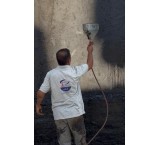
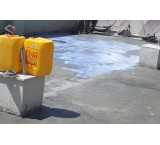
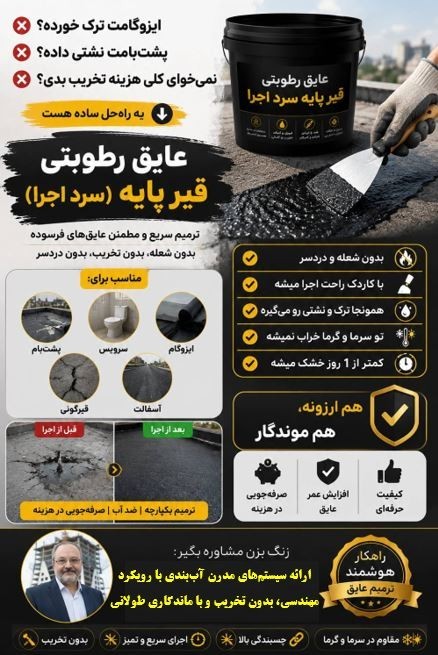
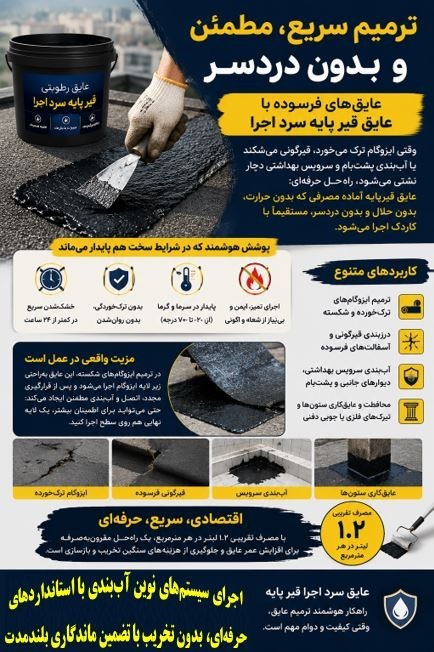
  • Ease and speed of application: Insulation with simpler execution and fewer equipment needs and less pollution ranks higher in choices. How to waterproof the roof using polymer insulations: Given the criteria above, newer polymer insulations rank higher for roof waterproofing. One of the best insulations for your roof is Stop Leak. This insulation is applied as a seamless coat with brush or roller, is very elastic stretching up to 4 times its length, and performs well in a temperature range of -50°C to +150°C. Simply first apply a primer as a seamless layer on the roof surface, parapet walls, penthouse walls, and any area to be waterproofed. Then reinforce only the corners with a 10 cm wide fiberglass mesh. The mesh adheres well to the primer without extra fixing. Now apply two layers of Stop Leak in your desired color over the entire surface. Your roof is waterproof. The image titled "How to waterproof the roof?" shows application methods and suitable insulation for roof waterproofing.

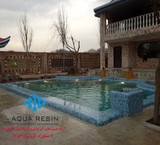
2- Water Feature Waterproofing: When waterproofing decorative water features, the main principle is not to compromise the final aesthetic beauty. Plus, as water features are near other elements like moisture-absorbing gypsum walls, waterproofing becomes an engineering and artistic task. **How to waterproof a water feature? ** Water features vary, so a single waterproofing method cannot be recommended for all. They may be wooden or stone, integrated with walls or standalone. Nearby materials vary greatly, including moisture-sensitive gypsum, wood that warps or breaks with moisture changes, or impermeable plastics. These factors affect waterproofing. For the best waterproofing method for your water feature, contact us for free consultation. Some general points: General rule for waterproofing water features: The main principle is consideration of the decorative aspect—waterproofing should not reduce artistic value. Use colorless insulations for waterproofing water features. How to waterproof a stone water feature? If stone, waterproofing is similar to that of stone facades, using penetrating or surface coatings explained in the stone facade section. How to waterproof a wooden water feature? For wooden features, wood must be fully sealed to be water-submersible. Mere water repellency is insufficient; full waterproofing is necessary. Wood waterproofing methods and suitable materials are detailed in the wood insulation section. The images titled "How to waterproof a water feature?" show suitable products and their usage for waterproofing water features.


3- Roof Garden Waterproofing: When selecting insulation for roof gardens, besides controlling irrigation wastewater, it is important to consider resistance against hydraulic pressure from roots and their secretions and chemical resistance to acids from organic decomposition in soil to avoid damage. **How to waterproof a roof garden? ** Key points for waterproofing a roof garden:

  • Don’t forget drainage installation.
  • Consider plant root pressure which can break asphalt and concrete.
  • Remember that soil and irrigation runoff are acidic due to fertilizers, root secretions, organic matter decomposition. Choose acid-resistant insulation.
  • Since soil and pots require replacement and maintenance like fertilizing and weeding, involving tools like shovels, which can physically damage insulation, select an impact-resistant waterproofing. A suggested waterproofing method:
  1. Cover surface with a 1 cm thick layer of Isocoat. Isocoat prevents root penetration and protects the substrate.
  2. Reinforce vertical-horizontal joints with mesh to prevent substrate cracking at corners.
  3. Use Stop Wet, a two-component polymer-cement insulation capable of resisting both positive and negative water pressure simultaneously for roof garden waterproofing. It is applied with brush or roller in two layers totaling 2 mm thickness, fully waterproofing the roof garden. Images titled "How to waterproof a roof garden?" show suitable products and their application in roof garden construction and waterproofing.

4- Brick and Tile Waterproofing: Direct waterproofing of brick and tile surfaces is a widely used application in construction. **How to waterproof brick and tile? ** First, use a penetrating, colorless waterproofing liquid to seal all pores and capillaries inside bricks or tiles. You can use Top Proof for this purpose. Top Proof is a colorless liquid similar to water that quickly absorbs into brick and tile surfaces without leaving traces but seals all pores to prevent water penetration. For complete waterproofing, apply two coats; the second coat after the first has dried using the same method. After the second layer dries, apply a Prolac layer over the surface for enhanced durability and a glossy finish. Images titled "How to waterproof brick and tile?" show suitable products and methods for brick and tile waterproofing.

There are no comments for this product
Titan permanent foundation

  • Trusted Company
  • Company registration date: -
  • Number of staff: 1-10 Person
  • Company activities: producer, Trading Company, Agents, Distributor and Wholesaler, Service company, Shop
  • Place: Iran, Province Tehran
  • In the field of: مصالح ساختمانی
  • Company Type: Private

Titan Banyan Mandagh Company, a producer of all kinds of polymer coatings and modern construction materials, which, in sync with the world's modern manufacturers, produces moisture, thermal, impact insulation and anti-corrosion coatings in accordance with the latest European methods and technologies and products in the class of international standards. It has been made available to the dear activists of the industry. This company has established and expanded its activity with the aim of changing the engineering attitude to the subject of coating (Coating) and specialization, and with this approach and inspired by the materials and methods used in developed countries, it has been able to build According to the concrete needs of the projects, it has expanded its products and brought nearly fifty different materials to the production arena in the field of covering all kinds of surfaces, each of which has been used in a specialized manner according to its properties and characteristics, so as to generalization and the damages caused by it should be avoided.\r\nThe quality of the company's products, many of which are exclusively produced by this group, and the optimal management practices adopted by Beckler in the Titan group, have been approved by national and international organizations. Is. Receiving the CE (Conformité Européene) European Conformity Certificate, TUV Institute QC Quality Control System Certificate, Q.A European Quality Assurance Certificate from the same institution and obtaining ISO 9001, 14001, 45001 and IMS standards is the result of the international and updated approach of Titan Bianyan Industrial Complex. This approach has been appreciated at the national level, and receiving the top national brand-national trust award from the national summit honoring the leaders of Iran's economy and obtaining a customer satisfaction certificate are among the honors that Titan Group has achieved in the shadow of such a view. \r\nThis is the basis for the trust of the loved ones involved in the industry in this group, the result of which has been manifested in the form of cooperation in the supply of materials and implementation of insulation, dozens of residential projects, both personal and cooperative, military, educational and industrial projects.\r\n Thank you for your warm presence with us, for a brief introduction to the various products and productions of the Titan Banyan Mandagh industrial complex, and to obtain more information, please continue to visit the Joishgar website or refer to the website of this complex at www.nanotitanco.com or the company page. Follow us on Instagram at @nanotitan.co and also on the Anti-Zaval Telegram channel at https://t.me/zeddezaval in providing more and worthy services.
Manufacturer of all kinds of anti-deterioration polymer coatings, modern construction materials including moisture, thermal, impact insulation and anti-corrosion coatings.

Contact Info: Titan permanent foundation
Companyتیتان بنیان ماندگار
Tel +98 21-0×××6366715 callMake Call
Mobile +98 912×××6715 callMake Call
Whatsapp Whatsapp link
Telegram Telegram link
Website https://www.nanotitanco.com
CountryIran
ProvinceTehran
Addressنیاوران جنب پمپ بنزین خیابان باهنر خیابان تناولی (مینا) پلاک 18 واحد 402
Postal code3155675936
Send pm Company Profile
FAQs

Do you have any question about this product?

The latest products in this category
Jooya
Jooya

Jooyeshgar AI Assistant

Press Enter to send, Shift+Enter for new line