Industrial Rotary Ventilator: Powerful and Free Ventilation of Warehouses Using Wind Power – Made from Durable Galvanized Sheet
Welcome to the world of efficient and economical industrial air conditioning! The industrial roof-mounted rotary ventilator is an ideal solution for ventilating your warehouses, factories, and storage facilities, continuously expelling unpleasant air, dust, and excess heat from the environment using only wind power, without any electrical energy. This natural ventilation system, with its intelligent design and sturdy galvanized sheet construction, is a sustainable and cost-effective option to improve air quality and create a healthier and more productive environment in your industrial spaces.
Detailed Features:
Specialized Installation on Various Industrial Roofs:
Technical Description: Industrial rotary ventilators are specifically designed and manufactured for installation on various types of industrial warehouse roofs, including single-slope and double-slope roofs. Installation usually takes place at the highest point of the roof (ridge or hip of the warehouse) to ensure optimal suction and air exhaust performance. For installation, a base or a square-to-round adapter, compatible with the structure and slope of the warehouse roof, is first fabricated and installed. Then, the main body of the rotary ventilator is placed on this base and secured firmly. This installation method provides strength as well as complete roof sealing.
Sturdy Structure Made of Galvanized Sheet:
Technical Description: The main body, blades, and base of these ventilators are made from high-quality galvanized sheet. Due to its zinc coating, galvanized sheet offers very high resistance against rust, corrosion, and adverse weather conditions (such as humidity and rain). This feature guarantees long product life and durability in industrial environments. The thickness of the galvanized sheet used typically ranges from 0.5 to 0.7 millimeters, providing necessary strength while remaining lightweight.
High-Quality Components for Optimal Performance:
Base: The base is the connecting part of the ventilator to the roof. As mentioned, this base is custom-designed and fabricated according to the roof type (single-slope or double-slope) and exact installation location (usually a square-to-round adapter) to ensure maximum stability and sealing. It is also made of galvanized sheet.
Bearings: The heart of the rotary ventilator is its bearing system. These ventilators are usually equipped with high-quality bearings (in some models, two bearings) that ensure smooth and nearly silent rotation of the cap even with gentle winds. Bearings are designed to require minimal maintenance and to resist dust and moisture.
Shaft: The shaft is the central axis connecting the blades and the rotating cap part to the bearings and base. It is typically made of durable steel to withstand stresses from rotation and wind force and to prevent vibration transmission to the roof structure.
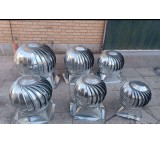
Blades: The blades are the main components generating suction force. These blades are made from galvanized sheet with a special aerodynamic curved and convex design. The shape and angle of the blades (blade pitch) are such that when air (wind) passes through them, lift force and consequently rotational torque are generated. This design allows the cap to rotate even at minimal wind speeds and exhaust indoor air outside. The spherical structure and regular blade arrangement ensure effective operation regardless of wind direction.
Operating Mechanism Based on Wind Power and Pressure Difference:
Technical Description: The rotary ventilator is a natural and passive ventilation system. Its operation is based on two principles:
Wind Power: Wind, even at low speeds, strikes the curved blades of the cap causing it to rotate around a vertical axis. This rotation acts like a turbine, directing air from inside to outside.
Stack Effect or Pressure Difference: Warm, lighter air inside the warehouse naturally rises. The rotating cap at the roof’s top creates a low-pressure zone at the outlet opening, significantly aiding the suction of this warm, polluted air outside. This process occurs continuously without any external energy.
Advantages:
Effective Ventilation of Unpleasant Air, Dust, and Pollutants:
The rotary ventilator continuously expels stagnant air, smoke, chemical vapors, unpleasant odors, and suspended particles like dust from the warehouse interior. This leads to a significant improvement in indoor air quality, providing a healthier environment for workers and better conditions for storing goods and equipment.
In welding workshops or paint shops, the rotary ventilator quickly removes harmful smoke and vapors, preventing their accumulation. In food or agricultural product warehouses, proper ventilation prevents spoilage caused by moisture and unpleasant odors.
Temperature Regulation Inside the Hall:
These ventilators help reduce indoor temperature, especially during warm seasons, by expelling hot air accumulated under the roof. This can reduce the need for costly cooling systems and increase thermal comfort for workers.
In a production warehouse where machinery generates significant heat, installing rotary ventilators can considerably lower the working environment temperature, preventing heat stress for workers and equipment wear.
No Electricity Consumption and Cost Savings:
One of the biggest advantages of the rotary ventilator is that it operates without electrical energy. This means zero electricity cost for ventilation and significant long-term operational cost savings.
For large warehouses requiring continuous ventilation, eliminating electricity costs related to electric fans can save a substantial amount annually in the company’s budget.
Almost Silent Operation:
Due to the use of high-quality bearings and absence of electric motors, rotary ventilators operate very quietly and almost noiselessly. This is highly valuable in environments requiring silence and concentration.
Easy and Fast Installation:
The installation process of these ventilators is simpler and faster compared to complex electric ventilation systems and usually has lower installation costs.
Low Maintenance and Long Lifespan:
Given the simple mechanical structure and use of durable materials like galvanized sheet and quality bearings, these ventilators require very little maintenance and have a long lifespan. Resistance to rust and corrosion contributes to this durability.
Environmentally Friendly:
Using renewable wind energy and no electricity consumption, these ventilators are a green and environmentally friendly ventilation solution that helps reduce carbon emissions.
Prevention of Moisture Accumulation and Related Problems:
Continuous ventilation through the rotary ventilator removes excess moisture inside the warehouse, preventing issues such as mold and fungus growth, corrosion of metal structures, and damage to goods.
Technical Specifications:
Body and Blade Material: High-quality galvanized sheet
Sheet Thickness: Usually 0.5, 0.6, or 0.7 millimeters
Main Components: Base (usually square-to-round adapter), bearing system (single or double), steel shaft, aerodynamic curved blades
Installation Type: Roof-mounted, on the ridge or highest point of single-slope and double-slope warehouse roofs
Operating Mechanism: Wind power and pressure difference (stack effect) – no electricity needed
Common Diameters: 15, 20, 25, 30, 35, 40, 45, 50, 55, 60, 65 centimeters (and in some cases up to 70 centimeters)
Noise: Very low, almost silent
Maintenance: Very low
Environmental Resistance: Resistant to rust, corrosion, moisture, and adverse weather conditions
New Advantages (Compared to Old Methods or No Ventilation):
Continuous and Automatic Ventilation Without Human Intervention: Unlike manual windows or vents, the rotary ventilator operates continuously and automatically with wind, requiring no manual opening, closing, or adjustments.
Higher Efficiency Compared to Fixed Roof Vents: Rotary ventilators create active suction through rotation, performing better than fixed roof vents in air exhaust.
Economical and Efficient Alternative to Expensive Electric Fans: In many industrial applications requiring general ventilation, rotary ventilators can be a very cost-effective alternative to electric fans, both in initial and ongoing costs (electricity and maintenance).
Comprehensive and Uniform Ventilation Coverage: Installing a suitable number of these ventilators at various roof points can achieve uniform ventilation throughout the warehouse space.
Functional Benefits:
High Efficiency Even with Low Wind Speeds: The aerodynamic blade design and smooth bearings enable these ventilators to rotate and ventilate even at low wind speeds.
Ability to Exhaust Large Air Volumes: Depending on the size and number of installed ventilators, a large volume of indoor air can be expelled in a short time.
No Air Backflow: The special blade design and rotational operation prevent exhausted air from re-entering the environment.
Durability and Stability in Various Weather Conditions: The sturdy structure and galvanized material ensure resistance against strong winds, rain, and snow.
Increased Workforce Productivity: By creating a more balanced temperature and cleaner air environment, worker comfort and health improve, leading to enhanced productivity.
The industrial roof-mounted rotary ventilator is a smart investment to improve air quality, reduce energy costs, and increase productivity in your industrial environments. This durable, efficient, and environmentally friendly product is an ideal solution for natural ventilation of warehouses, factories, storage facilities, and other large industrial spaces.
For specialized consultation, pricing information, and to order an industrial rotary ventilator tailored to your needs, contact us today. Our experts are ready to answer your questions and provide the best ventilation solutions for your industrial space.
Tehran