
There are no comments for this product
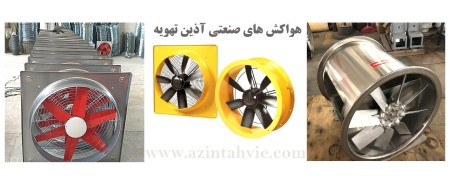
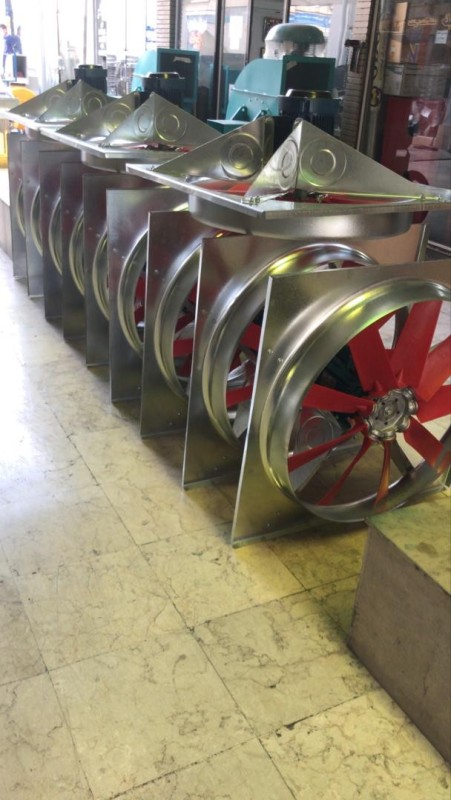
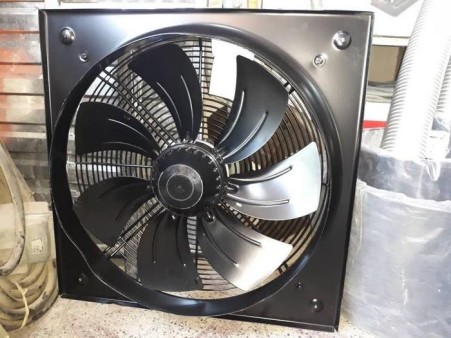
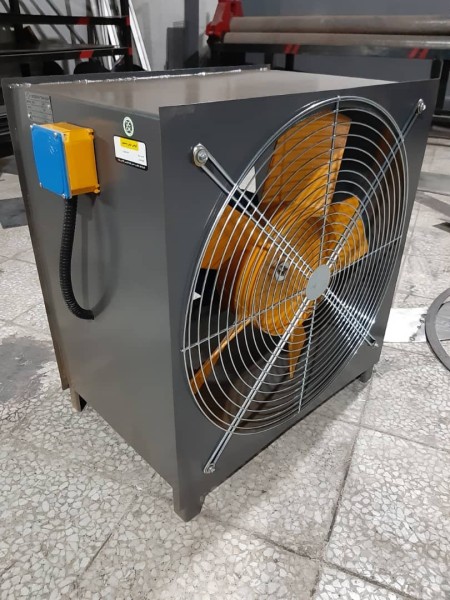
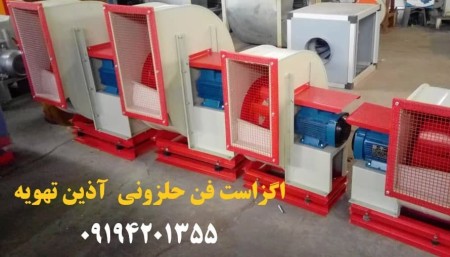


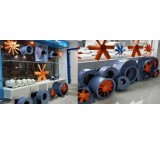
An exhaust ventilation fan, or suction and blower fan, is used to expel polluted air, warm air, and unpleasant odors or to inject fresh air in commercial and residential buildings, manufacturing factories, and industrial kitchens. Ventilators are usually designed and produced in two models: axial (propeller) fans and centrifugal (radial) fans. Various types of exhaust fans, depending on design and capacity, can be installed on walls, ceilings, and industrial equipment.
To achieve proper ventilation in different places, using one or more exhaust ventilation fans can yield the best results, because relying on natural methods and leaving doors and windows open for air exchange cannot provide adequate ventilation for workplaces and living spaces. Therefore, it is better to use blower and suction fans for this purpose.
Comprehensive review of exhaust fans and their vital role in HVAC architecture In today's world, where indoor air quality (IAQ) is as important as the physical structure quality of buildings, HVAC systems are no longer a luxury option; rather, they are the backbone of health and productivity in living and working environments. At the heart of these systems lie critical components responsible for the essential tasks of "cleansing" and "circulating" air. One of these key components is the exhaust fan; a term that, although simple, represents a complex and central function in environmental ventilation engineering.
This article from Azin TAHVIEH aims to clarify various aspects of exhaust fans—from their fundamental definition, components, and types of fans and ventilators to their place in the HVAC ecosystem—in language that is engaging for specialists and understandable for general audiences.
To understand the importance of an exhaust fan, we must first take a deeper look at the general concept of "ventilation." Ventilation is the process of replacing polluted air—which contains moisture, odors, smoke, volatile organic compounds (VOCs), and carbon dioxide—with fresh outdoor air.
Applications: Where exhaust fans are vital Exhaust fans have a wide range of applications, but in several key areas, their role is vital and irreplaceable: • Moisture-prone spaces (such as bathrooms and laundry rooms): To control water vapor and prevent mold and mildew growth, installing a centrifugal or axial exhaust fan with appropriate capacity is essential. • Kitchens and cooking environments: Removing smoke, suspended grease, and combustion byproducts (such as carbon monoxide in gas stoves) is the responsibility of the suction exhaust fan. • Workshops and industries: Removing toxic gases, suspended particles, dust, and chemical vapors to ensure worker safety. • Parking garages: Exhaust gases from vehicles must be regularly removed by a suction fan. • Central HVAC systems: In large projects, exhaust fans act as part of a balanced pressure system, expelling stale air so cooling and heating systems can operate at full efficiency.
How industrial exhaust fans work: Industrial exhaust fan operation is based on fluid physics principles, especially continuity and mass conservation: A) Creating negative pressure: The electric motor rotates the fan blades. This rotation draws air inside the fan housing rapidly toward the blade center and then expels it outward. B) Exhaust and replacement: As this volume of air exits, the internal pressure slightly decreases, creating a "partial negative pressure" state. C) Fresh air intake (Make-up Air): Nature always seeks balance. This pressure difference causes outdoor air at a desirable temperature (regulated by the HVAC system) to be drawn in through the easiest paths (such as under doors, special windows, or supply vents) to replace the exhausted air. In other words, the exhaust ventilation fan is not just an "exhauster"; it is the beating heart—the "driving motor"—of the entire conditioned air exchange process in a building.
An efficient exhaust fan is an engineered combination of several main components, each playing a complementary role in overall performance. Understanding these parts greatly aids selection, maintenance, and troubleshooting:
Exhaust Fan Components and Their Functions Component Brief Description Importance in Operation Impact on Price Impeller/Blade The main part moving air. Material, angle, and number of blades determine air displacement capacity (CFM) and static pressure. Mechanical heart; determines efficiency and airflow type (axial or centrifugal). Medium Electric Motor The energy source converting electrical energy into mechanical energy to rotate the impeller. Insulation type (e.g., waterproof or explosion-proof) depends on the working environment. Power supply; must be chosen according to fan load. High Outlet Damper A non-return system usually with movable blades. Prevents outside air from re-entering when the fan is off. Prevents energy loss (cooling/heating) and insect entry. Low Housing/Casing The body housing the impeller and motor, directing airflow. In duct fans, this is usually cylindrical. Protects components and shapes airflow paths. Medium Shaft & Bearings Connects impeller to motor. Bearings reduce friction and facilitate smooth rotation with minimal wear. Ensures smooth rotation and extends device life. Low Chassis and Vibration Isolator The body or frame on which the fan is mounted and fixed. Prevents vibration and shaking. Low
Exhaust ventilation fans can be classified from two fundamental perspectives, both directly affecting efficiency and installation location.
A) Axial Fans: Structure: Fan blades are directly in the airflow path, moving air parallel to the impeller shaft (like ceiling fans or wall-mounted fans). Application: Axial fans are suitable for moving large volumes of air at low static pressures (such as general ventilation, ceiling or wall fans).
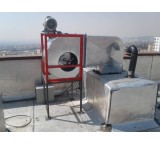
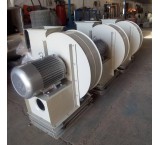
B) Centrifugal Fans: Structure: Air enters parallel to the shaft into the centrifugal impeller and is redirected 90 degrees by centrifugal force, expelled at high speed from the fan housing. Application: Suitable for systems requiring overcoming high resistance in ducts, filters, or equipment (high static pressure). Industrial centrifugal exhaust fans are widely used in central HVAC systems, long ductwork, and factories.
Determining exhaust fan prices is a multivariable formula that goes beyond the physical size of the device. In fact, industrial exhaust fan prices depend on various factors, some of which are listed below.
Key factors determining exhaust fan price: Air displacement capacity (CFM/CMH): This is the most important factor. Naturally, a high-capacity exhaust fan is more expensive than a lower-capacity one. Required static pressure: Fans that must overcome high resistance (like centrifugal duct fans) require stronger motors and more complex designs, increasing price. Construction material: As mentioned, stainless steel or fiberglass fans are much more expensive than spiral exhaust fans with carbon steel ST-37 bodies. Motor type: High-efficiency motors (such as IE3 or IE4) consume less electricity and, despite higher initial cost, reduce operational expenses over time. Accessories: Electric damper valves, acoustic enclosures (for noise reduction), or speed control (via inverter) increase the final fan and ventilator price.
When selecting and purchasing a ceiling exhaust fan, various parameters must be considered to choose a device with suitable capacity, material, dimensions, and noise level for the environment. As a professional rule, price alone should not be the sole purchase criterion; the ratio of "initial cost" to "lifecycle cost" (including electricity consumption and maintenance) should be evaluated. Sometimes, a more expensive model with higher efficiency is economically more viable over five years.
The exhaust fan, beyond being a simple device, is a key element in environmental engineering directly affecting the health, safety, and comfort of occupants. This device actively manages airflow, ensuring the indoor environment is free from stagnation and constantly exchanges air healthily with the outside world. Choosing the right industrial or residential exhaust fan requires deep understanding of its operation, required pressure type, and resistance material suitable for environmental conditions.
4 practical and frequently asked questions about HVAC systems and exhaust fans Here are four common questions often raised in implementation and consulting projects, along with expert answers:
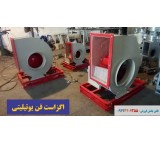
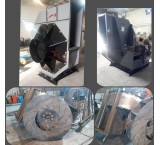
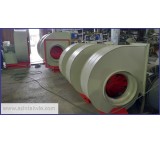
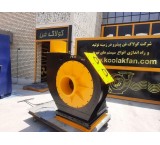
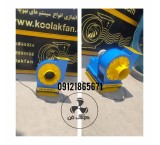
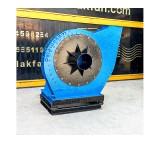
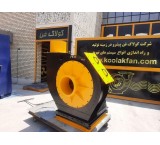
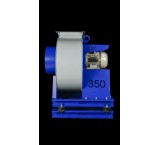
Blower and suction centrifugal fans
How do I calculate the required ventilator capacity or CFM for a home bathroom or restroom? Answer: A simple method is using the Air Changes per Hour (ACH) rule. For bathroom fans, the standard recommendation is usually at least 8 air changes per hour. First, calculate the bathroom volume (length × width × height) in cubic meters. Then multiply this volume by 8 and divide by 60 to get the required CFM (cubic meters per minute). (Example: A 3 cubic meter bathroom needs (3×8)/60=0.4 cubic meters per minute or 24 CFM. In practice, commercial fans of 100 to 150 CFM are installed for residential use.)
Does installing a fan much stronger than needed reduce HVAC system efficiency? Answer: Yes, definitely. If the exhaust fan is oversized and its exhaust capacity far exceeds the fresh air supply capacity, the building experiences severe negative pressure. This causes the central ventilation system to draw cold or warm air through cracks and gaps from outside rather than controlled ducts, significantly reducing thermal efficiency and increasing energy consumption.
In centrifugal fans, what do “backward curved” and “forward curved” blades mean, and which is better? Answer: Forward curved blades or forward fans achieve higher airflow with smaller motors but lose efficiency at high pressures and are often used in HVAC and air supply systems. Backward curved blades or backward fans perform excellently at high static pressures, are very quiet, and more energy-efficient (higher efficiency), but require stronger motors for the same airflow. In modern engineering systems, backward curved blades are preferred due to energy efficiency.
Below are some examples of products in the suction and blower exhaust fan groups that you can review and order after studying their specifications and features. For exhaust fan capacity estimation, you can contact Azin TAHVIEH technical experts to guide you in selecting the appropriate fan and ventilator.
Axial or propeller ventilators can be produced in various designs. These ventilators are used to exhaust polluted air. Industrial axial ventilators are produced in sizes from 20 to 180 cm with metal and plastic blades. Home ventilators can be used in bathrooms and toilets to ventilate air and eliminate moisture and bad odors. Wall-mounted axial ventilator prices can vary from 80,000 Tomans to 20 million Tomans. Axial exhaust fans or axial ventilators can be installed on walls, windows, or ceilings.
There are no comments for this product
| Company | آذین تهویه |
|---|---|
| Tel | +98 21-0×××4201355, +98 21-0×××4201355 |
| Mobile | +98 919×××1355 |
| Whatsapp link | |
| Instagram page | |
| Website | https://www.azintahvie.com/ |
| Country | Iran |
| Province | Tehran |
| Address | دفتر مرکزی: تهران، بلوار دریا، خ مطهری جنوبی، نبش 18 |



Jooyeshgar AI Assistant