
There are no comments for this product


Sale of XGSLAB10 with CYMEGRD8 and CDEGS - Sale of CYMEGRD8 and CDEGS17 and DIGSILENT2024 and DEHN CYMCAP ETAP2024 without limitation and with any number of users you want.
If you wish to purchase CYMGRD8 or CYMCAP or CDEGS or PLSCADD or CDEGS 17 and DEHN SUPPORT or DIGSILENT 2024 ETAP2024 or XGSLAB or PVSYST 8.06, contact 09126717215. In this post, a free download link for CYMGRD 6.3 is provided for engineers and students.
This company performs all grounding system calculations with CymeGRD8, ETAP2024, CDEGS, and XGSLAB software.
CYMGRD is software for designing and analyzing grounding systems, created to assist engineers in optimizing new network designs and reinforcing existing networks (of any shape). Advanced features in the software's graphical environment along with efficient analysis algorithms make this software a powerful tool that helps engineers create technically and economically sound designs.
If you wish to purchase CYMGRD8 or CDEGS17 or ETAP 20, contact 09126717215.
The term CDEGS, which stands for Current Distribution, Electromagnetic Fields, Grounding and Soil Structure Analysis, is a powerful integrated software suite designed by sestech for precise analysis of various electromagnetic problems occurring in all industries including electrical networks. Among these, only the SES (Safe Engineering Services & Technologies Ltd) software professionally addresses grounding system design. Some unique capabilities of this software compared to others include:
The SES software suite from Canada includes several software packages, with the CDEGS package being the most prominent.
The CDEGS software package consists of 8 modules: RESAP, MALT, MALZ, TRALIN, SPLITS, HIFREQ, FCDIST, FFTSES, or 12 software packages including AutoGround, MultiGround, MultiGround , MultiGroundZ, MultiGroundZ , MultiFields, MultiFields , MultiFieldsPro, MultilLines, AutoGridPro, AutoGroundDesign, Right-Of-Way.
CDEGS offers advanced solvers for the mentioned problems:
It covers all electromagnetic coupling modes:
CDEGS includes the following cores: RESAP: Soil Resistivity Analysis MALT: Low Frequency Grounding/Earthing Analysis TRALIN: Detailed Fault Current Distribution and EMI Analysis HIFREQ: Electromagnetic Fields Analysis FCDIST: Simplified Fault Current Distribution Analysis MALZ: Frequency Domain Grounding/Earthing Analysis SPLITS: Detailed Fault Current Distribution and EMI Analysis FFTSES: Automated Fast Fourier Transform Analysis
Supporting tools include Autotransient, CETU, FFT21Data, GraRep, GRServer, GRSplits, GRSplits-3D, ROWCAD, SESAmpacity, SESBat, SESCAD, SESConductorDatabase, SESConverter, SESCrossSection, SESCurveFit, SESeBundle, SESEnviroPlot, SESFcdist, SESFFT, SESGSE, SESImpedance, SESLibrary, SESPlot, SESPlotViewer, SESResap, SESResultViewer, SESScript, SESShield, SESSystemViewer, SESThreshold, SESTralin, SICLCommand, SoilModelEditor.
Each software package consists of a combination of several modules as detailed in the table.
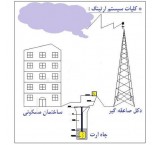
This software enables the design of grounding for substations, power plants, factories, and buildings. The design can be for uniform or two-layer horizontal soils and calculates touch and step voltages according to IEEE standards.
For grounding system calculations of solar power plants, considering that panel structures are part of the grounding system, calculations differ somewhat from typical substation grounding.
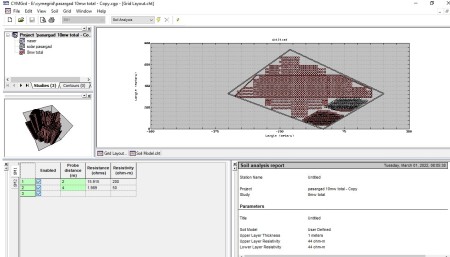
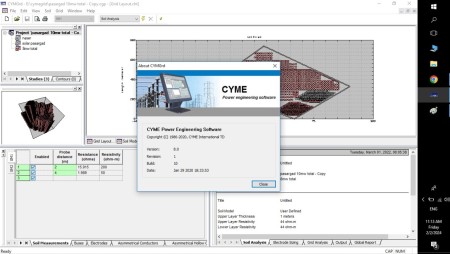
CYMGRD Screenshot 1 CYMGRD Screenshot 2
CYMGRD software is a substation grounding grid design and analysis program specially developed to help engineers optimize new grids and reinforce existing grids of any shape, featuring easy-to-use built-in danger point evaluation tools. User-friendly data entry, efficient analysis algorithms, and powerful graphical tools make CYMGRD an effective tool for technically sound and economical designs.
Program Features
CYMGRD allows rapid analysis of various design alternatives to choose economical solutions for any installation.
The program complies with IEEE 80™ 2000, IEEE 81™ 1983, and IEEE 837™ 2002.
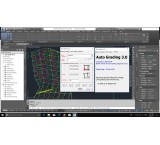
The CYMGRD/AutoCAD® Interface module
Allows switching between AutoCAD® and CYMGRD environments.
This utility is not a substitute for AutoCAD®, which remains required to produce *.DXF or *.DWG files containing the substation grid layout.
Simulation Results Management
More info (open/close)
DEHN Earthing Tool software calculates the required length of grounding electrodes according to IEC 62305-3 standard based on electrode types A and B and foundation electrodes. Soil resistivity is a key factor in determining electrode length. To purchase DEHN, call 09126717215.
◄ Necessity of grounding system ◄ Soil characterization ◄ Conductors and Rods tabs ◄ Settings for grounding system calculation ◄ Performing grounding system calculations ◄ Optimizing number of conductors and rods ◄ FEM method review ◄ IEEE method review
Grounding design with GSD: An online software for static grounding system calculations providing step-by-step simple design for electrical engineers. Calculation methods are based on formulas and relations recommended in BS 7430 and IEEE80 standards. Results are acceptable for engineering design; for more precise design, Tesla’s GLE software, approved by Amirkabir University, is recommended.
https://s25.picofile.com/file/8455555850/CYMGRD_V_6_3_R7.rar.html Password: cyme
First disable antivirus, then run grd637 file. After installation, place pk42mvdR.dll in the software installation folder (usually not in C drive). Then click CYMGRD inside the installation folder to run the software. If no error appears, installation is successful. If an error about missing SC32W file appears, copy contents of REQUIRED FILE folder into the installation folder to fix the issue.
Training for latest version CYMCAP 8.0 Rev2 Calculating appropriate cable size in various projects is one of the most important engineering tasks, often done manually. If the selected size is smaller than needed, cable damage or system malfunction may occur; if larger than necessary, despite proper function, economic design is compromised. Designers usually calculate cable size based on voltage drop and short circuit criteria, neglecting thermal sizing. For thermal sizing, especially in MV and HV cables, cable construction and layer specifications must be precisely modeled, and allowable current calculated based on installation environment such as underground, air, tunnels, ducts, trenches, etc. This course uses the professional cable sizing software CYMCAP to familiarize you with cable aspects, steady-state sizing, transient sizing based on current profile, estimation of temperature field around cables, calculation of magnetic flux density, induced voltage on shield, optimizing cable arrangement in duct banks, cable impedance matrix calculation, etc., based on IEC60853, IEC 60287, and Neher-McGrath methods.
There are no comments for this product
| Company | شرکت اهرام فناوری آذرخش |
|---|---|
| Tel | +98 21-0×××6717215 |
| Mobile | +98 912×××7215 |
| Whatsapp link | |
| Instagram page | |
| Website | https://www.dgsolar.ir |
| Country | Iran |
| Province | Tehran |
| Address | خ ستارخان روبروی برق الستوم-پلاک 790 |


Jooyeshgar AI Assistant