Sale of XGSLAB10 with CYMEGRD8 and CDEGS – sale of CymGRD8, CDEGS17, DIGSILENT2024, DEHN CYMCAP, ETAP2024 without limitation and any number of users you want.
If you wish to purchase CYMGRD8, CYMCAP, CDEGS, PLSCADD, CDEGS 17, DEHN SUPPORT, DIGSILENT 2024, ETAP2024, XGSLAB, or PVSYST 8.06, contact 09126717215. In this post, a free download link of CYMGRD 6.3 is provided for engineers and students.
This company performs all grounding system calculations with CymeGRD8, ETAP2024, CDEGS, and XGSLAB software.
CYMGRD is software for designing and analyzing grounding systems developed to assist engineers in optimizing new network designs and reinforcing existing networks (of any shape). Advanced features within a graphical interface combined with efficient analysis algorithms make this software a powerful tool that helps engineers create technically sound and economical designs.
If you want to buy CYMGRD8, CDEGS17, or ETAP 20, call 09126717215.
The term CDEGS stands for Current Distribution, Electromagnetic Fields, Grounding and Soil Structure Analysis. It is a powerful integrated software suite designed by sestech for accurate analysis of electromagnetic issues arising in various industries, including electrical networks. Among these, SES (Safe Engineering Services & Technologies Ltd) is the only professional software suite focusing on grounding system design. Unique capabilities of this software compared to others include:
Grounding system design at high frequencies
Optimal grounding system design for substations and power plants compared to other software
Designing grounding in soil with arbitrary layers (horizontal, vertical, spherical, cylindrical, defined volumes, etc.) used for specialized structures like dams
Fault current distribution in grounding networks
Lightning strike studies on transmission lines, telecom towers, wind turbines, nuclear plants, etc.
Analysis of transmission and distribution lines, power cables, EMI and EMC parameters
3D optimized lightning protection system design (lines, substations) per IEEE and IEC standards
Electromagnetic interference studies on nearby facilities like railways, oil/gas pipelines, etc.
Environmental electromagnetic effect analysis (corona, acoustic noise, radio noise)
SES software, from Canada, includes several packages, with CDEGS being the flagship:
Current Distribution, Electromagnetic Fields, Grounding and Soil Structure Analysis.
CDEGS software consists of 8 modules: RESAP, MALT, MALZ, TRALIN, SPLITS, HIFREQ, FCDIST, FFTSES, or 12 packages (AutoGround, MultiGround, MultiGround+, MultiGroundZ, MultiGroundZ+, MultiFields, MultiFields+, MultiFieldsPro, MultiLines, AutoGridPro, AutoGroundDesign, Right-Of-Way).
CDEGS offers advanced solvers:
Direct solutions for Maxwell's equations
Circuit-based analyses
Finite element methods
Inversion algorithms
Fourier analysis (FFT)
Transient analysis
Hybrid methods
The software supports all electromagnetic interaction modes:
Conduction via metal elements, coatings, and soil
Magnetic induction
Capacitive effects
CDEGS includes cores:
RESAP: Soil Resistivity Analysis
MALT: Low Frequency Grounding/Earthing Analysis
TRALIN: Detailed Fault Current Distribution and EMI Analysis
HIFREQ: Electromagnetic Fields Analysis
FCDIST: Simplified Fault Current Distribution Analysis
MALZ: Frequency Domain Grounding/Earthing Analysis
SPLITS: Detailed Fault Current Distribution and EMI Analysis
FFTSES: Automated Fast Fourier Transform Analysis
Assistive tools include Autotransient, CETU, FFT21Data, GraRep, and more.
Each package consists of modules as per the table:
This software enables grounding design for substations, power plants, factories, and buildings, including uniform and two-layer soils, calculating touch and step voltages per IEEE standards.
For solar power plant grounding calculations, considering that the panel structures are part of the grounding system, calculations differ somewhat from distribution substation grounding.
This software receives fault current magnitude and duration, soil thickness, soil resistivity, and body weight from the user and performs the following using soil, network, and diagram modules:
Soil module
Measures soil resistivity using one- or two-layer models, plots measured and computed resistances, and calculates maximum virtual touch and step voltages per standards.
Network module
Calculates current dispersion from each conductor into the soil, determines soil surface potential. Ground network can be a single conductor or multiple conductors arranged in a square, with 2D or 3D station layouts. Underground pipes and adjacent grounding networks can be included to assess their impact on fault currents and surface voltage.
Diagram module
Summarizes soil resistivity and surface potential analysis results on screen with 2D and 3D color graphics for better results presentation.
Key features of CYMGRD software:
Grounding system design at low frequencies (especially substation grounding per IEEE 80-2000)
Support for IEEE 80 2000, IEEE 81 1983, and IEEE 837 2002 standards
Finite element analysis of conductors and grounding rods
Calculation of station ground resistance (Rg) and ground potential rise (GPR)
Touch and surface potential analysis inside and outside the grounding grid with color display
Step voltage analysis
Support for symmetric or asymmetric networks of any shape
Modeling of return and distinct electrodes
Maximum single-phase to ground fault current calculation for a specified grid
...
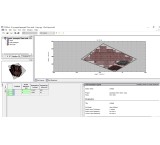
CYMGRD Screenshot 1 CYMGRD Screenshot 2
CYMGRD software is a substation grounding grid design and analysis program specially developed to help engineers optimize designs of new grids and strengthen existing ones of any shape, with easy danger point evaluation. User-friendly data entry, efficient algorithms, and powerful graphics help engineers deliver technically sound and economical designs.
Program features include rapid analysis of alternatives to choose economical solutions for installations and conformance to IEEE 80™ 2000, IEEE 81™ 1983, and IEEE 837™ 2002.
Analytical capabilities:
Finite element analysis of grid conductors and rods
Calculation of station ground resistance and ground potential rise
Touch and surface potential analysis with 2D/3D color displays
Step voltage analysis
Single or two-layer soil modeling
Reduction factor computation
Libraries of surface materials and soil resistivity values
Safety calculations for max allowable touch and step voltages per IEEE 80™ 2000
Current split factor estimation
Decrement factor calculation
Accounting for DC component of asymmetrical fault current
Electrode analysis for optimal sizing of conductors and rods
Support for symmetrical/asymmetrical grids
Modeling of arbitrarily located ground rods
Return and distinct electrode modeling
Concrete encased rod modeling
Max single-phase ground fault current computation
CYMGRD/AutoCAD® Interface module:
Allows alternating between AutoCAD® and CYMGRD environments. AutoCAD® remains required to produce .DXF or .DWG files of substation grid layouts.
Simulation results management:
Charts enable:
Graphical comparison of soil models to field measurements
Color-coded surface potential gradients with user thresholds
Equipotential contours in 2D/3D with adjustable viewing angles
Graphs of touch and step voltage along lines compared to safety thresholds
Visual indication of hazardous locations on 2D grid layouts
More info (open/close)
DEHN Earthing Tool software calculates required grounding electrode length per IEC 62305-3 based on electrode types A and B and foundation electrodes. Soil resistivity is key for electrode length determination. Contact 09126717215 to purchase DEHN.
Training topics:
◄ Grounding system requirements
◄ Soil characterization
◄ Conductors and rods tabs
◄ Settings for grounding calculations
◄ Executing grounding calculations
◄ Optimization of conductor and rod numbers
◄ FEM method review
◄ IEEE method review
GSD grounding design software: an online tool for static grounding system design providing step-by-step and simple design for electrical engineers. The method is based on formulas and recommended relationships from BS 7430 and IEEE80 standards. Results are acceptable for engineering design; for more accurate design, Tesla's computational software (GLE), approved by Amirkabir University, is recommended.
Software steps and features:
Register design and get a dedicated user panel
Short-circuit calculation in TN and TT networks considering distribution factors, X/R ratios, and IEEE80 recommendations
Interpretation of multi-layer soil resistivity to determine apparent resistivity and effective depth
Grounding system calculations including resistance, GPR graph, step voltage, touch voltage, protective device trip time, and selection of trip curve and device
Electrode and grounding conductor material selection
Generate official report in PDF format
Tested download link for CymGRD software V.6.3.R7:
https://s25.picofile.com/file/8455555850/CYMGRD_V_6_3_R7.rar.html
Password: cyme
Installation method:
Disable antivirus, run grd637 to install. After installation, place pk42mvdR.dll in the program folder (usually not in C drive). Run CYMGRD.exe to launch. If error about missing SC32W file occurs, copy REQUIRED FILE folder contents to install directory to fix the issue.
Training for latest CYMCAP 8.0 Rev2 software
Proper cable sizing in various projects is among the most important engineering tasks often performed manually. Undersized cables risk damage or malfunction; oversized cables cause economic inefficiency. Designers typically size cables based on voltage drop and short circuit but overlook thermal sizing.
For thermal cable sizing, especially MV and HV cables, cable structure and layer properties must be precisely modeled. Installation environments—underground, air, tunnel, duct, trench, etc.—affect allowable cable current.
This course introduces CYMCAP, the most professional cable sizing software, covering steady-state sizing, transient sizing considering current profiles, temperature field estimation around cables, magnetic flux density calculation, induced voltage on the shield, optimizing cable arrangements in duct banks, cable impedance matrix calculation, etc., following IEC60853, IEC 60287, and Neher-McGrath methods.
Tehran